2 Glossary
DLL : Dynamic-link library, a file that contains code and data which programs can load and use at runtime
Ghidra : A free, open-source software reverse engineering framework used to analyse and decompile binaries
Ping : The round-trip time (RTT) for data between a client and the server, measured in seconds
UE4 : Unreal Engine 4, a game engine developed by Epic Games
UT4 : Unreal Tournament 4, a game built on UE4 and developed by Epic Games
2.1 Table of variables
| Variable name | Description | Equivalence | Value |
|---|---|---|---|
| \(\text{TR}\) | Server tick rate (Hz) | \(30\) | |
| \({\Delta T}_s\) | Server tick period (s) | (\(\dfrac{1}{{\text{TR}}}\)) | \(\dfrac{1}{30} \approx 0.033\) |
| \(\text{FPS}\) | Client tick rate (Hz) | \(240\) | |
| \({\Delta T}_c\) | Client tick period (s) | (\(\dfrac{1}{\text{FPS}}\)) | \(\dfrac{1}{240} \approx 0.00417\) |
| \(\text{Ping}\) | Ping | RTT (s) | |
| \(\text{OWD}\) | One Way Delay (s) | (\(\dfrac{\text{Ping}}{2}\)) |
3 Prerequisite knowledge
This article assumes the reader
- has high school level mathematical proficiency
- is familiar with basic networking concepts
Derivations have been provided where possible.
Readers unfamiliar with the fundamentals of concepts discussed are strongly encouraged to consult additional sources to gain a full understanding.
4 Introduction
Midair was a community and externally funded multiplayer first-person shooter released on Steam in May 2018, developed by Archetype Studios. It aimed to be a spiritual successor to the Tribes franchise, belonging to a subgenre colloquially referred to as FPS-Z (first-person shooters with a significant vertical axis). The defining mechanic is momentum-based skiing, where players exploit terrain slopes to reach extreme speeds, combined with a jetpack for vertical movement and projectile-based weapons that reward leading fast-moving targets. The project spanned between 2014 and 2019, funded initially via a Kickstarter campaign before ultimately shutting due to being a buggy, incomplete, unbalanced mess that could no longer be maintained due to fledgling resources.
Central to Midairs identity, and the subject of this article, were claims made by the development team and the broader community regarding the quality of the game’s netcode and lag compensation. These claims were numerous, persistent, and emphatic - spanning years of forum posts, Discord messages, Reddit comments, and YouTube videos.
This article examines those claims through two complementary approaches: a mathematical analysis of the lag compensation mechanism, and a code analysis via reverse engineering of the publicly available Midair client. The findings are unambiguous. Midairs netcode is stock Unreal Engine 4 with no meaningful modifications. The lag compensation is a direct copy of Epic Games’ Unreal Tournament 4, reduces mathematically to a single naive kinematic offset, and is covered under a license that explicitly prohibits its use in other projects. The claims made about these systems are not merely overstated - they are false.
5 Background and claims
The implementation of Midairs lag compensation and custom tailored netcode is credited to Bazika “Mabel (Mabeline)” Huffman-Kinyalolo.
Quoting directly from Midairs Kickstarter:
Custom Tailored Networking
Modern First-Person Shooters require highly customized netcode and lag compensation to ensure that players around the world can enjoy games without worrying about the effects of packet loss, latency, and server location. We have spent and will continue to spend a great amount of effort to specially design our netcode to achieve this end, enabling all players with under 150ms to have the same, high-quality experience. During pre-alpha testing we have brought in players from a variety of FPS-Z titles across both North America and Europe to ensure we provide a seamless cross-continent experience that trumps all others.
There are dozens upon dozens (totaling a number probably somewhere in the hundreds) of posts/comments across various forums (e.g. Discord, Legions: Overdrive forums, Reddit, YouTube, etc) since Midairs inception till now which make claim to the superior performance and implementation of Midairs netcode and lag compensation.
Unfortunately two of the largest resources, the official Midair forums (playmidair.com), and official Midair discord, have both been essentially “nuked”.
5.1 Midair today
In early 2020 a new independent studio called Vector Z Studios began development for Midair: Community Edition, which was eventually renamed to Midair 2. As of the writing of this article, Midair 2 remains in development.
Also, as of the writing of this article, analysis performed via reverse engineering confirms that Midair 2 uses the same netcode and lag compensation as Midair.
5.2 Claims (quotes)
The provided quotes do not serve any real purpose other than entertainment (or cringe fuel) due to the fact they are grossly overstated, and raise serious questions about the authors credibility. The remarks suggest either a misunderstanding of the facts or a deliberate distortion (i.e. shilling).
5.2.1 Generic claims
A very small collection of relevant claims (quotes) I found via googling certain keywords related to Midair are provided below.
Netcode is really, really good and is getting even better as time passes. We have Euros playing on NY servers and not being disadvantaged.
- Darklord (Ex-Midair 2 developer) on April 27, 2016
Midair is coming along quite nicely. The testers have regular pickup games and even in its pre-alpha state it plays very well; things like the netcode have been written from the ground up already to support advanced lag compensation.
- PROJTHEBENIGNANT on May 5, 2016
What you’re getting is essentially an updated t1/t2c but with amazing net code/lag comp, matchmaking to find balanced, fun games and the possibility of an alive player-base which is something you won’t be getting with the older tribes games.
- WorkingAsIntended on May 5, 2016
…and we (finally!) have some exciting netcode improvements like lag compensation. All of these are pretty huge for the game experience. Lag compensation alone opens up a huge amount of options. Users across the whole of the US can play on the same server with basically no issues
- Mabeline (Midair developer) on May 8, 2016
T:A is very ping dependant while Midair will lag compensate everything so pings below 150 will feel like 0 ping.
- Shreq (Ex-Midair 2 developer) on May 27, 2016
Yeah big time. The best in the business in fact, you won’t find better lag comp in the market.
- Wildefyr on August 26, 2017
One of the founding members of the original dev team, Mabel, wrote a bunch of netcode. My understanding is the lag compensation is a lot better than default ue4
- ehme (Midair 2 developer) on August 7, 2020
Midair 2 netcode is really good. Projectiles are the hardest to get right and it nails it on all fronts. Mabel was originally in charge of it and did an amazing job.
- Cykon on December 12, 2023
Nearly perfect netcode has been achieved before in Midair. You can be very generous with it in Tribes games according to Mabel.
- afireinasa on December 18, 2023
Yeah its bad luck because in previous patches the netcode was top notch even at 150+ ping
- Aesdotjs (Midair 2 developer) on February 19, 2024
5.2.2 Archetype Studios
A collection of relevant claims (quotes) I found via searching transcripts of YouTube videos related to interviewing Archetype Studios or videos posted by the official Archetype Studios channel itself are provided below.
So I know the way that the netcode works is has been heavily modified by Mabel in particular. There’s been a lot of effort spent on getting this right… and some of the benefits we see from that are some nice smooth gameplay especially with inconsistent ping and latency and that sort of thing. But yeah, so it was like one of the other benefits is actually cross region play…
- BugsPray (Midair developer, CEO of Archetype Studios) on March 20, 2016
As far as consistency goes, the guys going through and making the game right now they put a lot of work into the netcode… and the netcode in this game is pretty remarkable, especially for an FPS-Z game.
- GuitarGuy on May 8, 2016
Yeah the other thing thats contributing to that is Mabel is something of a savant when it comes to netcode… the netcode we have in Midair is second to none.
- Unknown on May 8, 2016
We’ve actually done something really cool with Midair in particular with match making, so we’ve taken Unreals netcode and stripped out a bunch and done a bunch of our own work to it and one of the neat impacts of that is that we are going to have cross region play for matchmaking. Which is super neat because it means that, and we actually do that now, I in Seattle play all the time with people in Europe in a server in New York.
- BugsPray (Midair developer, CEO of Archetype Studios) on August 29, 2017
6 Research questions
This article specifically seeks to answer the following questions:
- What is Midairs lag compensation doing mathematically? Is it reducible to a known formula, and if so, how well does it actually perform?
- Was Midairs netcode custom built? Or is it stock Unreal Engine 4 with superficial (or no) modifications?
- Was Midairs lag compensation custom built? Or was it sourced from an existing codebase?
- Are the claims made about Midairs netcode and lag compensation accurate? Or are they overstated, misleading, or outright false?
7 TL;DR
- Midair uses stock standard UE4 netcode (replication, UNet*)
- Midairs lag compensation uses basic kinematics
- Midairs lag compensation is copied from Epic Games UT4
- Epic Games UT4 repository license clearly says it’s code may not be used in another project
- Midair heavily relies on client-side simulation to fake reduction of latency (e.g. fake projectiles)
- Any perceived benefits of Midairs lag compensation system is largely placebo
- Mabel, BugsPray, the Midair development team and notable members of the community made a conscious effort to mislead those who would not investigate any further
8 Theory
8.1 Defining netcode and lag compensation
Netcode is defined as the part of a game’s programming that manages communication between the client (player) and the server.
Lag compensation is defined as the techniques used to reduce the perceived effect of network latency (i.e. ping).
In the gaming community, these terms are often confused, however they represent two very different concepts and should NOT be used interchangeably.
8.2 Predicting the location of moving objects
8.2.1 Continuous time domain
As formulated in the kinematic equations, the position of a moving object under ideal conditions can be expressed as \[ s\left(t\right) = s_{0} + v_{0}t + \dfrac{1}{2}a{t}^2 \] where \[ \begin{split} t &: \text{time} \\ s_{0} &: \text{initial position} \\ v_{0} & : \text{initial velocity} \\ a & : \text{acceleration} \\ \end{split} \]
Define acceleration as a constant.
Let \(t > t_0 \geq 0.\)
\[ \begin{equation} a = \dfrac{dv}{dt} = \dfrac{d^2s}{dt^2} \end{equation} \]
\[ \begin{split} \dfrac{dv}{dt} &= a \\ \int_{t_0}^{t}{dv} &= \int_{t_0}^{t}{a \cdot dt} \\ \left[v\right]_{t_0}^{t} &= a\left[t\right]_{t_0}^{t} \\ v\left(t\right) - v\left(t_0\right) &= a \cdot \left(t - t_0\right) \\ v\left(t\right) &= v\left(t_0\right) + a \cdot \left(t - t_0\right) \\ &= v\left(t_0\right) + at - at_0 \end{split} \]
\[ \begin{split} \dfrac{ds}{dt} &= v \\ \int_{t_0}^{t}{ds} &= \int_{t_0}^{t}{\left(v\left(t_0\right) + at - at_0\right) \cdot dt} \\ &= \int_{t_0}^{t}{v\left(t_0\right) \cdot dt + at \cdot dt - at_0 \cdot dt} \\ \left[s\right]_{t_0}^{t} &= \left[v\left(t_0\right) \cdot t + \dfrac{1}{2}at^2 - at_0 \cdot t\right]_{t_0}^{t} \\ s\left(t\right) - s\left(t_0\right) &= \left(v\left(t_0\right) \cdot t + \dfrac{1}{2}at^2 - at_0 \cdot t\right) - \left(v\left(t_0\right) \cdot t_0 + \dfrac{1}{2}a{t_0}^2 - at_0 \cdot t_0\right)\\ s\left(t\right) &= s\left(t_0\right) + v\left(t_0\right) \cdot t + \dfrac{1}{2}at^2 - at_0 \cdot t - v\left(t_0\right) \cdot t_0 - \dfrac{1}{2}a{t_0}^2 + a{t_0}^2 \\ s\left(t\right) &= s\left(t_0\right) + v\left(t_0\right) \cdot t - v\left(t_0\right) \cdot t_0 + \dfrac{1}{2}at^2 - at_0 \cdot t + \dfrac{1}{2}a{t_0}^2 \\ &= s\left(t_0\right) + v\left(t_0\right) \cdot \left( t - t_0 \right) + \dfrac{1}{2}a\left(t^2 - 2 t_0 \cdot t + {t_0}^2\right) \\ &= s\left(t_0\right) + v\left(t_0\right) \cdot \left( t - t_0 \right) + \dfrac{1}{2}a\left(t - {t_0}\right)^2 \end{split} \]
For convenience, we set \(t_0 = 0\).
\[ \begin{split} \therefore s\left(t\right) &= s\left(0\right) + v\left(0\right) \cdot \left( t - 0 \right) + \dfrac{1}{2}a\left(t - 0\right)^2 \\ &= s\left(0\right) + v\left(0\right) \cdot \left(t\right) + \dfrac{1}{2}a\left(t\right)^2 \\ &= s_0 + v_0t + \dfrac{1}{2}at^2 \end{split} \]
8.2.2 Working in the discretised time domain
Physics calculations in video games are evaluated in discrete time, not continuous time as above.
When working with discrete time steps the continuous differential kinematic equation is instead represented by its discrete time analogue - a difference equation, as follows \[ \begin{split} s_{n+1} &= s_{n} + v_{n}\Delta t_n + \dfrac{1}{2}a_{n}\left(\Delta t_n\right)^2 \end{split} \]
where
\[ \begin{split} \Delta t_n &: \text{time step} \\ s_{n+1} &: \text{final position at step n+1} \\ s_{n} &: \text{initial position at step n} \\ v_{n} & : \text{initial velocity at step n} \\ a_{n} & : \text{acceleration at step n} \\ \end{split} \]
Player movement in UE4 is server authoritative which means the server is the one and only source of truth. During each tick the server will factor all input forces to eventually calculate a players final location and final velocity for said tick. This information is then communicated to clients, which then further simulates the remote players movement until a subsequent update is received from the server.
Therefore, on the client, the difference kinematic equation is simplified to \[ \begin{split} s_{c_{n+1}} &= s_{c_{n}} + v_{c_{n}} \Delta T_c + {\epsilon}_n \end{split} \]
where \[ \begin{split} {\epsilon}_n &: \text{error (due to smoothing, corrections, etc)} \end{split} \]
given
\[ \begin{split} s_{c_{0}} &: \text{initial position received from server} \\ v_{c_{0}} &: \text{initial velocity received from server} \\ \end{split} \]
constrained by \[ \begin{split} n \cdot \Delta T_c < \Delta T_s \end{split} \]
This constraint conveys that the equation is only valid for a specific number of steps - until the client receives a new update from the server.
This equation performs simple extrapolation of a players position between receiving updates from the server. The rate at which these updates occur is simply equal to \(\text{TR}\). At a given step the position on the client will delayed by approximately \(\text{OWD}\) with respect to the actual position on the server for the same step.
Whatever process the server/client actually uses to calculate/predict a players location in UE4 is practically irrelevant. The aforementioned equations simply help to provide a simplistic high level model of what is happening under the hood.
8.2.3 Error between the client and server
The error between the client predicted location and actual server position is affected by both ping and the server tick rate.
This equation can be loosely modelled as
\[ \begin{split} \Delta \text{Error}_{n} &\approxeq {s}_{{s}_{n}} - {s}_{{c}_{n}} \\ &= \underbrace{\left( {s}_{{s}_{0}} + \sum_{i = 1}^{\lfloor \text{OWD} \cdot \dfrac{1}{\Delta T_s} \rfloor}{\Delta s_{{s_i}}} \right)}_{{s}_{{s}_{n}}} - \underbrace{\left( {s}_{{s}_{0}} + \sum_{i=1}^{n}{\Delta s_{{c_i}}} \right)}_{{s}_{{c}_{n}}} \\ &= \sum_{i = 1}^{\lfloor \text{OWD} \cdot \dfrac{1}{\Delta T_s} \rfloor}{\Delta s_{{s_i}}} - \sum_{i=1}^{n}{\Delta s_{{c_i}}} \\ &= \underbrace{\sum_{i = 1}^{F}{\Delta s_{{s_i}}}}_{S} - \underbrace{\sum_{i=1}^{n}{\Delta s_{{c_i}}}}_{C_n} \\ &= S - C_n \end{split} \]
where
\[ \begin{split} F &: \text{number of server ticks elapsed since latest server update received by client} \\ n &: \text{index of client tick since latest server update received by client} \\ s_{{s}_0} &: \text{initial position received from server by client} \\ v_{{c}_0} &: \text{initial velocity received from server by client} \\ \Delta s_{{s_i}} & : \text{change in server position during server tick $i$} \\ \Delta s_{{c_i}} & : \text{change in client position during client tick $i$} \\ \\ S &: \text{total change in server position since latest server update received by client} \\ C_n &: \text{total change in client position since latest server update received by client} \\ \end{split} \]
constrained by
\[ \begin{split} N \cdot\Delta T_c & < \Delta T_s \end{split} \]
Using the client as the frame of reference, at \(n = 0\) (the step the client receives an update from the server), the error is reduced to
\[ \begin{split} \Delta \text{Error}_{0} &\approxeq S - C_0 \\ &= S \\ &= \sum_{i = 1}^{\lfloor \text{OWD} \cdot \dfrac{1}{\Delta T_s} \rfloor}{\Delta s_{{s_i}}} \\ &\approxeq \Delta {{s_1}} + \Delta {{s_2}} + \cdots + \Delta {{s_{{\lfloor \text{OWD} \cdot \dfrac{1}{\Delta T_s} \rfloor}}}} \\ &\approxeq v_1\Delta T_s + v_2\Delta T_s + \cdots + v_{{{\lfloor \text{OWD} \cdot \dfrac{1}{\Delta T_s} \rfloor}}}\Delta T_s \\ \end{split} \]
For the given step the client only has the information for \(v_0\) and \(\text{Ping}\). Thus the only simple and realistic way to approximate this error in terms of what the client knows is
\[ \begin{split} \Delta \text{Error}_{0} &\approxeq v_1\Delta T_s + v_2\Delta T_s + \cdots + v_{{{\lfloor \text{OWD} \cdot \dfrac{1}{\Delta T_s} \rfloor}}}\Delta T_s \\ &\approxeq v_0 \cdot \text{OWD} \end{split} \]
If a client has a RTT ping of \(\text{Ping}\) with respect to the server, then said clients view of the world will be \(\dfrac{\text{Ping}}{2}\) (i.e. \(\text{OWD}\)) seconds in the past.
8.2.4 Minimisation of error (compensating for lag)
We have formulated an expression for the approximate error using only information accessible to the client at the step at which it receives an update from the server. Now we can attempt to formulate an updated difference equation which minimises said error.
\[ \begin{split} \Delta \text{Error}_{0} &\approxeq S - C_0 \\ &\approxeq v_0 \cdot \text{OWD} \\ \\ \Delta \text{Error}_{0} - v_0 \cdot \text{OWD} &\approx S - C_0 - v_0 \cdot \text{OWD} \\ &\approx 0\\ \\ \therefore S - \left(C_0 + v_0 \cdot \text{OWD} \right) &= S - \hat{C_0} \\ &\approx 0\\ &= \hat{\Delta \text{Error}_0} \end{split} \]
Thus to attempt in minimising the error we can shift the players location by \(v_0 \cdot \text{OWD}\) at the specified step.
The difference equation for the client can now be updated to \[ \begin{split} s_{c_{n+1}} &= s_{c_{n}} + v_{c_{n}} \Delta T_c + {\epsilon}_n \end{split} \]
where \[ \begin{split} {\epsilon}_n &: \text{error (due to smoothing, corrections, etc)} \end{split} \]
given
\[ \begin{split} s_{c_{0}} &: \text{initial position received from server} + v_0 \cdot \text{OWD}\\ v_{c_{0}} &: \text{initial velocity received from server} \\ \end{split} \]
constrained by \[ \begin{split} n \cdot \Delta T_c < \Delta T_s \end{split} \]
This is the exact same equation as the original simply with a change in initial value for \(s_{c_{0}}\).
The thought process behind this form of lag compensation can be described as: “I know my client is \(\text{OWD}\) seconds in the past compared to server. To combat this, the client shall simply guess where other players will be \(\text{OWD}\) seconds in the future”.
It is extremely simple, naive and generally ineffective (as discussed further below).
8.2.5 The effects of ping on error
Clearly as a players ping increases, so does the total error between the client predicted location and the actual server position.
The error is not linearly proportional to the ping.
As acceleration may be chaotic the resulting error may also be inherently chaotic. This will result in the client side error approximation to be inaccurate to an unacceptable degree.
This form of prediction is only useful (i.e. accurate to an acceptable degree) within a certain threshold of ping. This threshold is governed mainly by how fast players move and how often they receive changing movement inputs.
Therefore, as the pace of a video game increases, the effective threshold decreases.
8.2.6 The effects of server tick rate on error
Generally the effects of server tick rate on the total error are negligible. Increasing the server tick rate does not reduce errors in prediction due to ping, but can reduce error during position simulations on the client.
8.2.7 When does error minimisation prediction work
Obviously the error minimisation prediction derived above works to an acceptable degree (in regards to accuracy) if a player maintains constant velocity (i.e. zero acceleration) for \({\lfloor \text{OWD} \cdot \dfrac{1}{\Delta T_s} \rfloor}\) server ticks since the last server update on the client.
This can be further explained using plots - where the location is mapped to an arbitrary sinusoidal function (which has the properties of having both non-constant velocity and acceleration).
The plot below shows a players position both server side and client side (for varying amounts of RTT ping) when no lag compensation is applied.
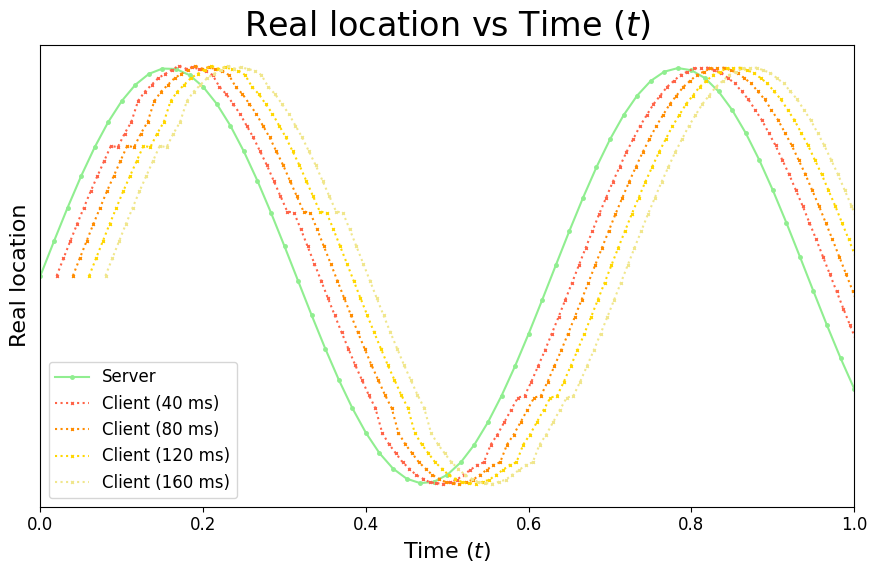
As the ping increases, so too does the lag between the server side (real) player position and client side (local) player position.
Next, we apply the error minimisation prediction as our form of lag compensation.
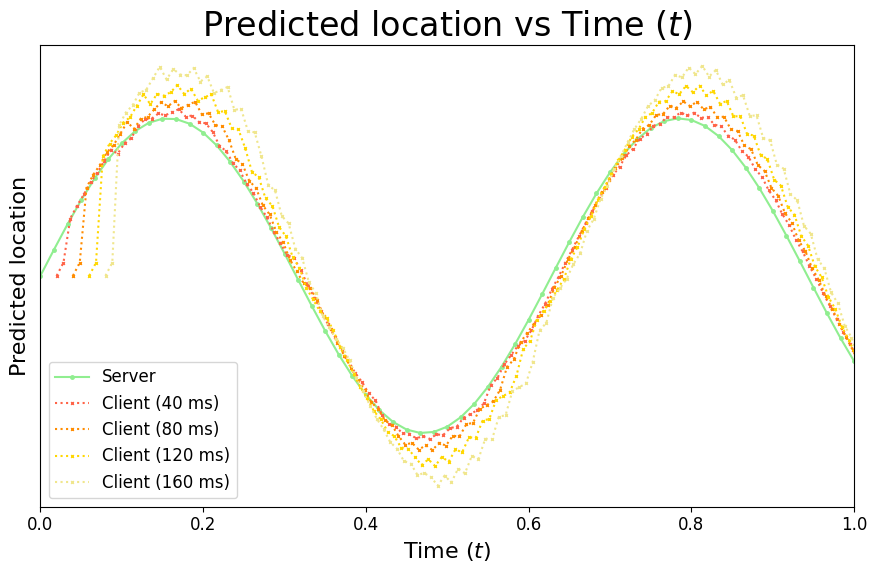
The client side player position (predicted) is nowhere near accurate to the server side (real) player location when the acceleration is non-zero. Conversely, we can clearly see that the client side player position (predicted) is relatively accurate to the server side (real) player location when the acceleration is near zero.
9 Preparations for analysing Midairs lag compensation
9.1 Server hosting
Any analysis performed must require an isolated Midair server for our client to connect to. As Midair never shipped with any server hosting tools, this functionality must be developed independently through reverse engineering and/or any other techniques.
This process is outside the scope of this investigation and will be omitted.
9.2 Server side player position recording and playback
To gather consistent and accurate data a server side mod must be developed to simulate player movement. Essentially, the player will move in a preset path so we can conduct our analysis accordingly.
This process is outside the scope of this investigation and will be omitted.
9.3 Identifying the existing mechanisms for lag compensation in the Midair client
The Midair client uses a console command to set the degree of lag compensation to perform. This console command is called Predict. It’s usage is documented as follows: Predict <value> (i.e. Predict 160).
Once player position playback is running server side, the Predict value can be varied to see the effects of lag compensated player position on the client.
The Predict console command is NOT a part of UE4. This is a custom console command that was introduced by the Midair development team.
It’s logic and implementation is actually plagiarised from UT4. More on this will be covered later below.
10 Mathematical analysis of Midairs lag compensation
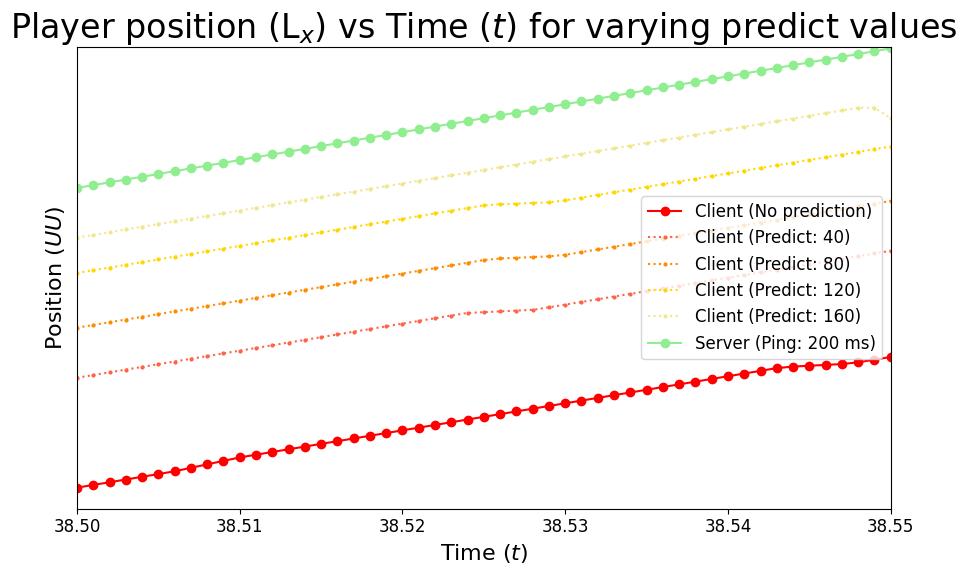
10.1 Replaying a set path with varying Predict values
Choosing an arbitrary axis (X in this case) and replaying a set path for varying Predict values produces the results as shown below. As the predict value increases we see the error decrease. A key thing to note however is that in this image the position appears to be almost linear, which is why this prediction appears to be working well.
10.2 Setting up for a linear regression
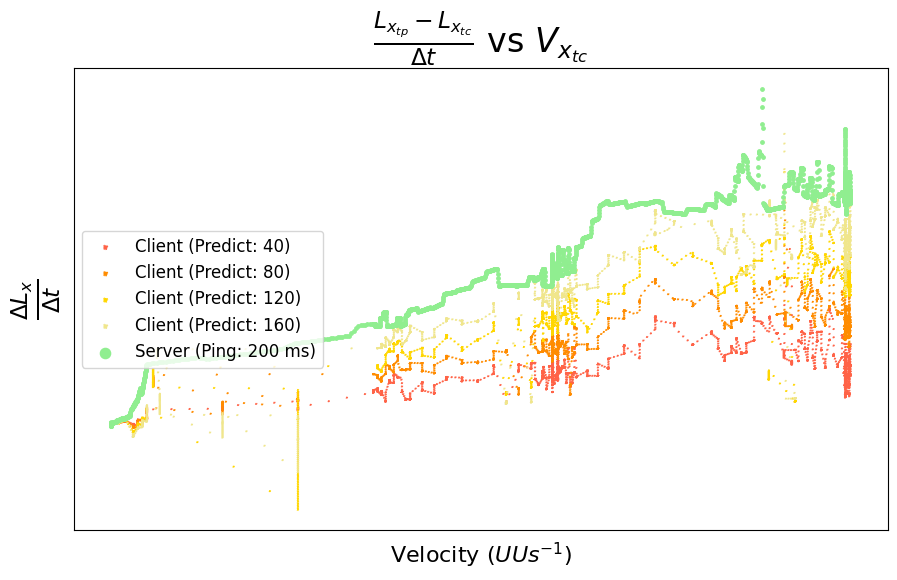
Assume that the predicted position can be expressed as a linear function of the initial position and initial velocity multiplied by a scalar related to Predict (\(K\)).
\[ \begin{split} L_{x_{t_{p}}} &= L_{x_{t_{c}}} + K \cdot V_{x_{t_{c}}} \cdot \Delta t \end{split} \]
where
\[ \begin{split} L_{x_{t_{p}}} &: \text{predicted position at t} \\ L_{x_{t_{c}}} &: \text{initial position received from server by client} \\ V_{x_{t_{c}}} &: \text{initial velocity received from server by client} \\ K &: \text{Predict value multiplied by a scalar} \end{split} \]
Rearrange the equation as follows
\[ \begin{split} L_{x_{t_{p}}} &= L_{x_{t_{c}}} + K \cdot V_{x_{t_{c}}} \cdot \Delta t \\ \dfrac{\left(L_{x_{t_{p}}} - L_{x_{t_{c}}}\right)}{\Delta t} &= K \cdot V_{x_{t_{c}}} \end{split} \]
Let \(\Delta t = \dfrac{1}{1000} = 0.001\) so our velocity scalar (\(K\)) will be computed in milliseconds.
A plot of this equation is provided below.
10.3 Performing a linear regression
Simply apply the OLS (Ordinary Least Squares) method for linear regression.
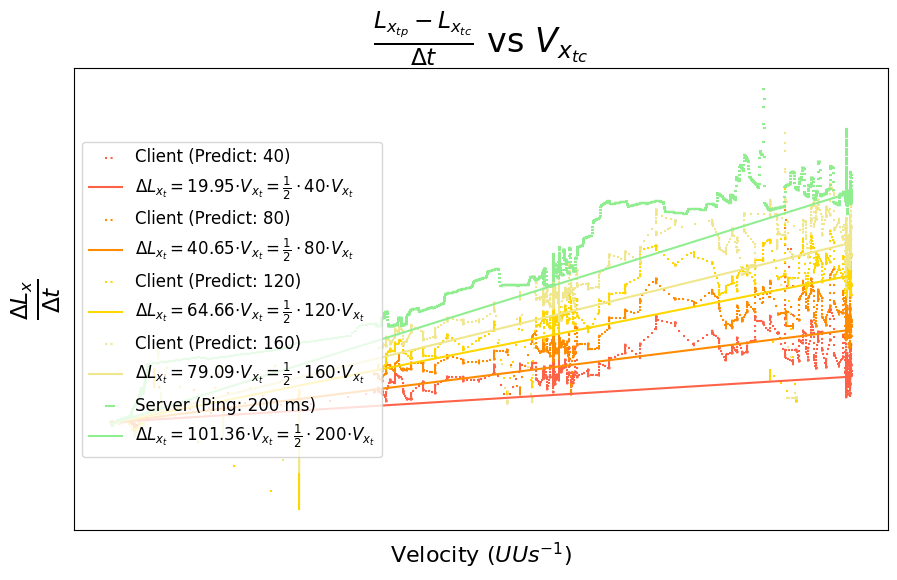
Representing the results above in tabular form we can see that \(K \approx \dfrac{\text{Predict}}{2}\).
| Predict value | Regression slope (\(K\)) | Regression slope \(\div\) Predict value |
|---|---|---|
| 40 | 19.95 | 0.50 |
| 80 | 40.65 | 0.51 |
| 120 | 64.66 | 0.54 |
| 160 | 79.09 | 0.49 |
The difference equation for the client can now be expressed as \[ \begin{split} s_{c_{n+1}} &= s_{c_{n}} + v_{c_{n}} \Delta T_c + {\epsilon}_n \end{split} \]
where \[ \begin{split} {\epsilon}_n &: \text{error (due to smoothing, corrections, etc)} \end{split} \]
given
\[ \begin{split} s_{c_{0}} &: \text{initial position received from server} + v_0\left(\dfrac{1}{2}\cdot\dfrac{\text{Predict}}{1000}\right)\\ v_{c_{0}} &: \text{initial velocity received from server} \\ \end{split} \]
constrained by \[ \begin{split} n \cdot \Delta T_c < \Delta T_s \end{split} \]
Now, for the case where \(\text{Ping} \cdot 1000 \leq \text{Predict}\),
\[ \begin{split} s_{c_{0}} &: \text{initial position received from server} + v_0 \cdot \text{OWD}\\ \end{split} \]
This is the exact same equation as what was derived in the final part of Section 8.2.4!
Thus conclusively proving that Midairs lag compensation is simply using the kinematic equations.
The Predict command sets the prediction limit in milliseconds.
11 Code analysis of Midairs lag compensation and netcode
I won’t go too much into this because if you don’t understand code then this won’t make much sense to you… and if you do understand code then this is pretty simple and straight forward.
The folks at Vector Z Studios were kind enough to ship the earliest release of Midair: Community Edition with a PDB (Program Database) file.
I’ll use the PDB in combination with the Midair: Community Edition client in Ghidra to find certain functionality related to lag compensation and netcode. Only functions will be listed, as providing class definitions and their comparisons will be too time consuming.
I’ve linked relevant sections of code from the official UT4 source code that are associated with the code identified in Midair.
11.1 Analysing lag compensation
11.1.1 GetPredictionTime
float __thiscall AMAPlayerController::GetPredictionTime(AMAPlayerController *this)
{
  float Ping;
  ENetMode EVar2;
  float PredictionTime;

  EVar2 = AActor::InternalGetNetMode((AActor *)this);
  if ((EVar2 != NM_Standalone) && (this->_padding_ != 0))
  {
    Ping = this->SmoothedRTT;
    PredictionTime = 0.0;
    if ((0.0 <= Ping) && (PredictionTime = this->MaxPredictionPing * 0.001, Ping <= PredictionTime))
    {
      PredictionTime = Ping;
    }
    return PredictionTime * 0.5;
  }
  return 0.0;
}
Returns \(\dfrac{1}{2}\text{Ping}\) if \(\text{Ping} < \dfrac{\text{Predict}}{1000}\) else \(\dfrac{1}{2} \dfrac{\text{Predict}}{1000}\). \(\text{Predict}\) in this case refers to the MaxPredictionPing variable inside the AMAPlayerController class.
The UT4 equivalent function is float AUTPlayerController::GetPredictionTime.
The logic is practically identical.
Note that the function and variable names have been kept identical.
11.1.2 ServerNegotiatePredictionPing_Implementation
void __thiscall AMAPlayerController::ServerNegotiatePredictionPing_Implementation (AMAPlayerController *this,float NewPredictionPing)
{
  float MaxPredictionPing;

  pUVar1 = UMAGameEngine::GetPrivateStaticClass();
  pUVar2 = pUVar1->ClassDefaultObject;
  if (pUVar2 == NULL)
  {
    (**(code **)(pUVar1->_padding_ + 0x358))(pUVar1);
    pUVar2 = pUVar1->ClassDefaultObject;
  }
  MaxPredictionPing = 0.0;
  if ((0.0 <= NewPredictionPing) && (MaxPredictionPing = *(float *)(pUVar2 + 0x5b), NewPredictionPing <= *(float *)(pUVar2 + 0x5b )))
  {
    MaxPredictionPing = NewPredictionPing;
  }
  this->MaxPredictionPing = MaxPredictionPing;
  return;
}
The implementation of the Predict console command.
The UT4 equivalent function is void AUTPlayerController::ServerNegotiatePredictionPing_Implementation.
The logic is practically identical.
Note that the function and variable names have been kept identical.
11.1.3 MAUpdateSimulatedPosition
void __thiscall AMACharacter::MAUpdateSimulatedPosition(AMACharacter *this,FVector *param_1,FRotator *param_2)
{
  float PredictionTime;
  ...

    if (this->MACharacterMovement != NULL)
    {
      pbVar2 = (byte *)((longlong)&this->MACharacterMovement->_padding_ + 7);
      *pbVar2 = *pbVar2 | 0x20;
      PredictionTime = UMAGameplayStatics::GetCatchUpTime((AActor *)this); // Same as calling GetPredictionTime
      if (0.0 < PredictionTime)
      {
        (**(code **)(this->MACharacterMovement->_padding_ + 0x910)) // Same as calling UMACharacterMovement::SimulateMovement
                  (this->MACharacterMovement,PredictionTime);
      }
    }
  ...
}
Performs the prediction of player position.
The UT4 equivalent function is void AUTCharacter::UTUpdateSimulatedPosition.
The logic is practically identical.
Note that the function and variable names are almost identical. The prefix ‘UT’ has been replaced by ‘MA’.
11.1.4 Other functions
Listing all the functions used for lag compensation, their code, what they do, and finding their equivalents from UT4 would be overly exhausting.
Instead I’ll provide a table of function names from Midair and their equivalent function from UT4.
| Midair function | UT4 function |
|---|---|
| AMAProjectile::BeginFakeProjectileSync | AUTProjectile::BeginFakeProjectileSynch |
| AMAProjectile::InitFakeProjectile | AUTProjectile::InitFakeProjectile |
| AMAProjectile::CatchUp | AUTProjectile::CatchUpTick |
| AMAPlayerController::Predict | AUTPlayerController::Predict |
| AMAPlayerController::ServerNegotiatePredictionPing_Validate | AUTPlayerController::ServerNegotiatePredictionPing_Validate |
The list goes on and on. The logic used in the Midair functions and their equivalent UT4 function is practically identical.
Note that the function names are almost identical.
11.1.5 Findings
Midairs lag compensation system is clearly copied from UT4.
In fact, Mabel loosely admitted to it in a reddit post as quoted below.
For other players, we basically decide to ‘split the difference’ to hide latency. You predict other players ahead by about 1/2 your RTT, and when the server sees you fire things, it basically ‘fast forwards’ your projectiles from their predicted point in time (1/2 RTT ago, basically). This is done to mitigate the effect of player movement misprediction errors, hiding some of the latency on the receiving end of projectiles.
…
This is essentially the same model that Reflex and UT4 use. We’re able to use prediction because we don’t have very precise hitboxes, we basically just have big capsules jumping around and you really don’t need pixel-perfect accuracy to hit individual hitboxes. If we did, we’d have to use a model more like Overwatch as we simply couldn’t deal with misprediction errors that bad. If you’ve ever played OW with >200 ping (which is around where it starts doing prediction) you can see how fast the hitreg starts failing when the game starts using prediction.
- Mabeline (Midair developer) on May 9, 2016
The UT4 repository license is quite clear about the usage of its assets from the repository.
11.2 Analysing netcode
I won’t waste my time going into a deep explanation of my findings regarding Midairs “custom tailored” netcode. Midair uses stock UE4 netcode. If there were any modifications made to the netcode, their impact is practically negligible. In fact, contextually, Midair did not require any modifications to the netcode in the first place to perform at an acceptable benchmark.
A quote from an ex-Midair 2 developer confirms this.
netcode is mostly just stock ue netcode iirc
- Implosions (Ex-Midair 2 developer) on August 2, 2025
All videos I could find involving Archetype Studios developers which mentioned the application of their custom netcode actually referred to their lag compensation system. As mentioned in Section 8.1, these two terms are NOT interchangeable.
12 How does Midairs lag compensation work?
12.1 Prediction
Already covered fairly extensively above.
12.2 Fake projectiles
Fake projectiles (also called client-side predicted projectiles) are visual-only representations of projectiles spawned immediately on the shooter’s client when they fire, before the server confirms the shot.
The server runs its own authoritative simulation of the projectile separately. The client’s projectile is “fake” because it doesn’t determine hit results - it just exists to mask latency.
12.2.1 How it works
- Player fires and the client instantly spawns a fake projectile moving towards the target
- The input is sent to the server, which spawns the real projectile and simulates it authoritatively
- When the server result arrives, the fake projectile is either destroyed quietly or reconciled with the real one (the latter in the case of Midair)
12.3 How good is Midairs lag compensation?
At low pings (30ms or under), it’s fine. As the ping increases, the game state on the client becomes more and more inaccurate. The use of fake projectiles mask the perceived latency resulting in a placebo effect regarding the efficacy of the lag compensation.
It’s a simple trade off - a responsive game client side in return for an inaccurate game state.
The game lies to you about its real states to hide latency and feel responsive. As ping increases, the game remains responsive, however, the lie becomes bigger. Sometimes, the lie just happens to be accurate, and you manage to successfully land shots. However, majority of the time, even if you aim perfectly for your client game state, your shot will not land.
No.
It would probably pass for UT4, but, Midair isn’t UT4.
In fact, there’s a few glaring issues with this lag compensation implementation, essentially leaving it incomplete. One major issue being the amount of leading required remains a function of ping, which defeats the purpose of lag compensation in the first place.
12.4 How does it compare to Tribes titles
It’s basically the same functionality as PFT (Predict Forward Time) from Starsiege: Tribes and Interpolate from Tribes 2, just a smoother implementation (the player models do not teleport/warp as much during prediction thanks to what’s happening under the hood in UE4). This smoother implementation comes at the obvious cost of updating large positional changes slowly, which results in (unnoticeable) desync.
Tribes: Ascend has no form of lag compensation.
Tribes 3: Rivals uses a similar but more complete implementation that provides better overall results with the occasional non-reg at higher pings (again, due to unnoticeable desync).
13 What alternatives are there?
13.1 Server-side rewind
Server-side rewind (also called lag compensation via history buffers) is the industry standard approach. Rather than guessing where a player will be in the future on the client, the server maintains a rolling history of every player’s position over recent time. When a client fires a shot and the server receives that input, the server rewinds world state back to the moment the client fired (accounting for ping), evaluates the hit against that historical snapshot, and then restores the present state.
13.1.1 Why it is strictly better
- Accuracy is not a function of acceleration: because the server replays recorded positions rather than extrapolating from velocity, the result is accurate regardless of whether the target was accelerating, decelerating, or changing direction at the time of the shot.
- The shooter hits what they aim at: from the shooter’s perspective, if they aim correctly at the target visible on their screen at the moment of firing, the shot registers. This is not guaranteed under Midairs model.
- The trade-off is shifted, not eliminated: the receiver of a shot may feel they were hit “around a corner” - a well-known side effect. However, this is a far more acceptable and consistent artefact than shots simply failing to register.
13.1.2 Implementing server-side rewind in Midair
An example of a server-side rewind implementation in Midair is provided below.
This process is outside the scope of this investigation and will be omitted.
14 Conclusion
The findings of this investigation are unambiguous.
Mabel, who was directly and publicly credited as the architect of these systems, repeatedly and demonstrably misrepresented the nature of the work. The broader community of developers, ex-developers, and prominent players who amplified these claims - many of whom are quoted in this article - either lacked the technical understanding to scrutinise them or chose not to. Either way, the result was that a paying community was misled for years about the quality of a product they funded.
The technical reality is straightforward: Midair shipped a game with stock UE4 netcode and plagiarised, rudimentary lag compensation, wrapped in marketing language designed to sound impressive to an audience unlikely to investigate further. The claims were not just overstated - they were false.
14.1 How did this happen?
The straightforward answer is cronyism - and it is almost inevitable in communities built around dead or dying franchises.
In a healthy consumer relationship, there is distance between the developer and the audience. Critics can be critical. Players can be skeptical. A bad product receives honest feedback. In a community-developed successor project, that distance does not exist. Criticising the game means criticising your friends in a community you depend on for social belonging. Skepticism about the netcode means implicitly questioning Mabel, who everyone knows personally and who is generally liked and hailed as a “genius”. The social cost of honest scrutiny is high, and the reward is low - so almost nobody does it.
This dynamic allowed a simple pattern to persist for years: one person made a technically impressive-sounding claim, people who trusted that person repeated it, and the repetition created the appearance of consensus.
In Midair 2, of which the development includes several people who were part of or adjacent to the original Archetype Studios circle, repeated these same claims years after the original game had shut down . This is not coincidental. The same cronyist dynamic that shielded the original claims from scrutiny carried them forward intact into the successor project, where they continue to circulate today.
It is worth being clear: this is not a phenomenon unique to Midair. It is the default mode of operation for community-developed successors to niche dead franchises. The Tribes community is simply a particularly well-documented example of it.
15 Response
15.1 Midair community
Unsurprisingly, the response from the Midair community has been overwhelmingly negative towards the findings this article. I won’t bother to include quotes of the numerous cringe inducing responses because the authors are clearly deranged.
It seems Mabel slander will not be tolerated… despite the fact he deliberately misled a community that trusted him. Or, perhaps they just can’t handle the fact the game they cherish so much is a dead, technically mediocre product built on borrowed code and propped up by years of unchallenged myth.
15.2 Vector Z Studios
- Midair was retired from the steam store weeks after the posting of this article
- The development team has begun implementing their own attempt at server-side rewind solution for Midair 2
16 Other findings
16.1 Failure to deliver Kickstarter goals
As mentioned in Section 5, Midair was initially funded using Kickstarter, which listed “Custom Tailored Networking” as one it’s features.
Now that the game has released and been abandoned, let’s take a look at the list of features the Kickstarter promised, and which (if any) features were delivered.
| Feature | Delivered | Information |
|---|---|---|
| Free to Play | ⚠️ | Technically it was free to play. However the game required either paying or excessive grinding to be playable, resulting in early and almost instantaneous death on public release |
| Maps & Map Making | ❌ | |
| Stats & Rankings | ❌ | |
| Achievements | ⚠️ | No idea if this was actually implemented |
| Game Replays | ❌ | |
| Custom Tailored Networking | ❌ | As discussed by this article, this is provably false |
Archetype Studios raised $128,416 via Kickstarter and didn’t really seem to deliver on anything they said they would.
16.2 Over $500,000 of combined sales and funding
A quote from the Co-Founder/CFO/COO of Archetype Studios LinkedIn page is presented below.
// Co-founded an independent game studio of 23 volunteers/paid employees; primary role in finance and business operations, including Marketing, Legal, and HR. Combined sales and funding over $500,000.
Allen Kuceba (Co-Founder/CFO/COO of Archetype Studios)
An internal source to Archetype Studios has alluded to management closing the Kickstarter early once they had raised a large enough sum of funding and obtained external funding. This raises serious questions about the integrity of the campaign considering they could barely accomplish a single Kickstarter goal let alone even ship a functional product.